Decanter Centrifuge
SALIENT FEATURE
* Co-Current design
* Simple, rugged construction
* Tow - three-phase separation process
* Rotor comprising screw conveyor inside conical/cyinderical bowl
* Screw conveyor (single flight or multiple flights), with or without hard surfacing
* Conveyor and bowl in various stainless steel : SS 304 , SS 316/316 L
* Solids discharge through collecting channel and hard-surfaced scrapers
* Wear protection of conveyor flights in tungsten carbide
* Wear protection (interchange able ) of conveyor systems
* Drive by electric motor and V-belt with gear box for high strength and reliability
* Oil lubrication for gear box and greasing for bearings
* Overload protection device
* Fixed differential speed variation
* War protection including inter changeable tungsten carbide tiles
* Automatic differential speed variation on request
* Vibration dampers
OPERATION SYSTEM
* Separation takes place in Horizontal conical / cylindrical bowl with screw conveyor.
* The slurry in feed into the bowl through a staationery inlet tube and accelerated by specially design inlet distributor.
* Centrifugal force leads to instant sedimentations of the solids on the wall of bowl.
* The conveyor , rotating in the same direction as with differential speed, conveys the solids to conical end. The solids are lifted clear of the liquid and centrifugally dewatered before being discharged into the collecting channel.
* The clarified liquid flows into the housing through opening in cylindrical end of the bowl.
TYPICAL APPLICATIONS
* Treatment and disposal processes of sludge form municipal and industrial waste water
* Drying of animal slurry
* Inorganic products aluminum hydroxide, barium sulphate, lead oxide, chromium oxide ferrous hydroxide, magnesium hydroxide, titanium dioxide, zinc sulphate, etc.
* Organic products carboxymet hylcellulose, caprolactam, dimethylterephthalate, terephthalic acid, phthalic acid, etc.
* Plastics carboxymethycellulose, caprolactam, dimethylterphthalate, terephathalic acid phthalic acid, etc.
* Silicates asbstos , clay, etc.
* Cellulose de-inking flotation concentrate.
* Foodstuffs fishmeal, casein, whey, etc.
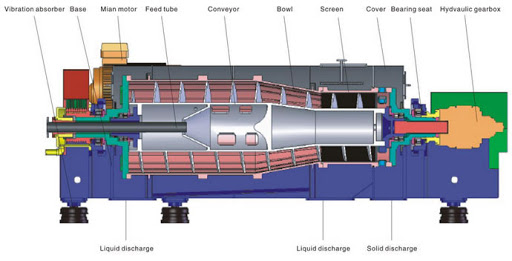
Solids Discharge:
This is where the dewatered solids drop. Normally, screw conveyor with a valve or diverter gate is position bedfellow the discharge . This is because for the first few second after star up liquid will come out of the solids discharge of a centrifuge.
Solids Deposited:
There are the settled solids. They for man annular, 360 degree, shape around the bowl, and being conveyed forward by the scroll/screw of the centrifuge at a rate relative to the differential speed.
Liquids Discharge:
This is the liquids discharge end of the centrifuge, this liquids is still dirty, and is end bakc to the head of plant. The water looks clear or slightly turbid, with a usual capture rate of 95----98%.
Feed Pipe:
This is where the sludge is fed, one some machine, the feed pipe is on the other end of the machine. The sludge is fed upon half way through this feed pipe, at which time the sludge is release and by the centrifuge force, the solids settle along the outside of the bowl. This is adjustable for optimization.
Clarified Liquid Pond:
This is the separated liquid part of the centrifuge, once the liquid reaches the outlet level, the liquid begins to discharge.
Cylindrical Section: 90% of the dewatering occurs in this section.
Beach (Conical Section):
This section is designed to exert additional force on the solids, squeezing out the last drops of liquids as are not only applying the centrifugal G– for but also pushing the solids uphill. It is designed to elevate the solids above the water line into the discharge chamber. The angle of inclination canary from 8 to 15 degrees depending on the sludge character rustics.
Drive System:
The centrifuge is equipped with a drive system composed of an electric motor, a hydraulic motor, hydraulic pump and cycle gear box. The electric motor provides the power required to turn the complete rotating assembly driving the drum directly and the scroll through the hydraulics. Controlling the differential speed between the drum and the scroll in PLC Controlled. The PLC Controls the working cycle as well as the protection in case of torque overload
Copyright © 2020, Water 2 People Teknologies Pvt. Ltd. All Rights Reserved.